The Swimming Postmen |
|
|
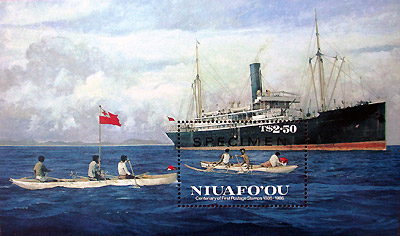
The Union Steam Ship Co. had ships on regular runs carrying fresh fruit and other food as well as general trade between the many islands of the Pacific. Thus they frequently passed Nuiafo'ou when sailing from Fiji and Samoa but were unable to come inshore as there was no beach, the waters too deep and the currents too treacherous and strong. |
|
|
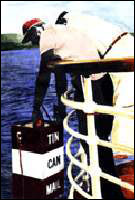
The Post Office in Nuku'alofa agreed to gather any mail destined to Nuiafo'ou and seal it in kerosine or 40-lb ships' biscuit tins. By soldering these securely tight, the air inside kept them floating so that they could safely be thrown overboard. A flag was attached so swimmers could more easily locate them. As soon as the ship was sighted, swimmers would set out carrying any out-going mail wrapped in greaceproof paper on the end of a stick to keep it dry. A basket was then lowered over the side to lift up the mail. |
|
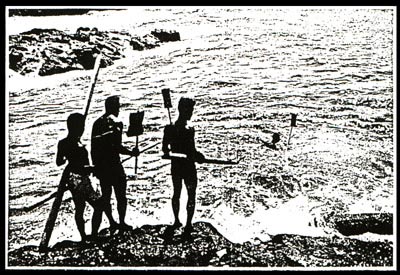 |
It would normally take an hour or more to swim the distance. Sometimes, when the sea was particularly rough, it could take the swimmers as much as 6 hours to do the round trip to a ship standing by just one mile off shore! This is because of the strong currents to be found around the island. |
|
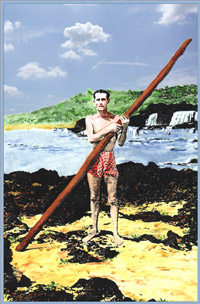
Charles Ramsay, one of the plantation managers was the only white man to swim for the mail, which he did 112 times both by day and by night. Yes, if it happened to be dark as the ship approached the island, the captain would blast the siren and then wait for a given time. If no one came out, the ship would continue and the mail had to wait till the next trip round. Just one of the dangers was for the swimmers to find their way back to their tiny island in the dark and so villagers would light bonfires along the cliff tops to guide them back. |
 |
 |
To enable the swimmers to stay afloat for these lengths of time, they placed a long Fau pole under one arm. This is a very boyant wood from the Hibiscus family and gave them something safe to hang on to and support them. |
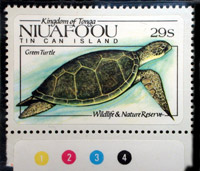 |
It was so successful that in fact it was in this way that the villagers used to fish! |
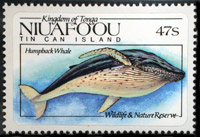 |
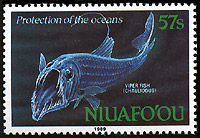
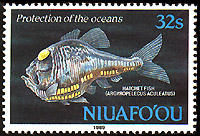
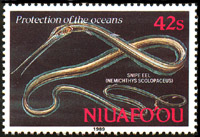
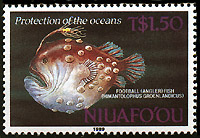
| Remember Nuifo'ou is the tip of a volcano rising up from the Tongan trench - regarded by many as the deepest part of the Pacific where all manner of little-known deep-sea fish dwell. |
 |
|
 |
 |
 |
 |
||
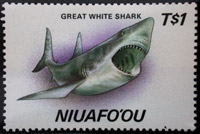 |
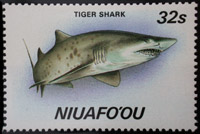
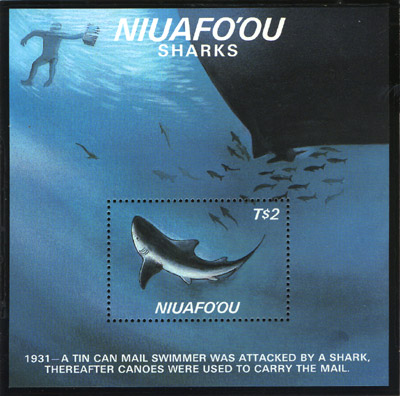
The waters around the island were rich in fish - and also in sharks and it was in these waters the swimming mailmen had to carry their letters - so if your postman moans about the neighbour's pooch, show him this! Ramsay was terrified of these sharks, as he writes in his accounts of his swims; and inevitably the day came, in 1931 it was, when one of the swimming postmen was indeed attacked by a shark. |
|
 |
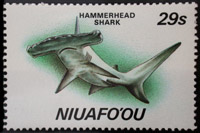 |
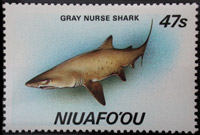 |
| His colleagues were able to drag him back to land and as he lay on his deathbed, he admitted to the chief that, in a fit of temper, he had opened the tap on the village water tank.
There was no fresh water on the island but it did lie in the hurricane belt so, in each village huge concrete tanks stored the water for the rest of the year. The chief said this was indeed a serious offence and obviously the Gods had punished him! It is the only reported case of a shark attack and indeed the only known case of someone committing so heinous a crime! |
 |
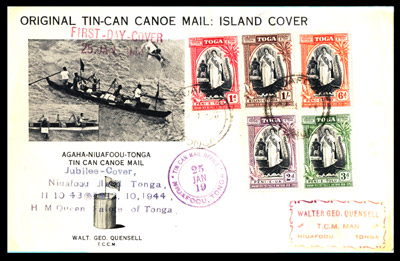 |
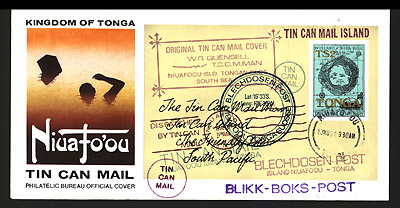
Queen Salote and her government were very upset by this incident and ordered that in future the mail had to be carried by canoe. However, with the difficulty of lowering the canoes from the cliffs there is some doubt whether this was always done. One can imagine that, as the preferred way was to jump into the water and then climb aboard the canoe, they were already wet and probably found it less of a hassle to just swim. The main reason for this doubt is that at the end of 1934 Quensell, who organised the swimmers and added the cachets, wrote a letter to a friend in which he said that he feared Tin Can Mail might soon come to an end because his people were demanding $10 per swim - and going on strike if he refused. |
|
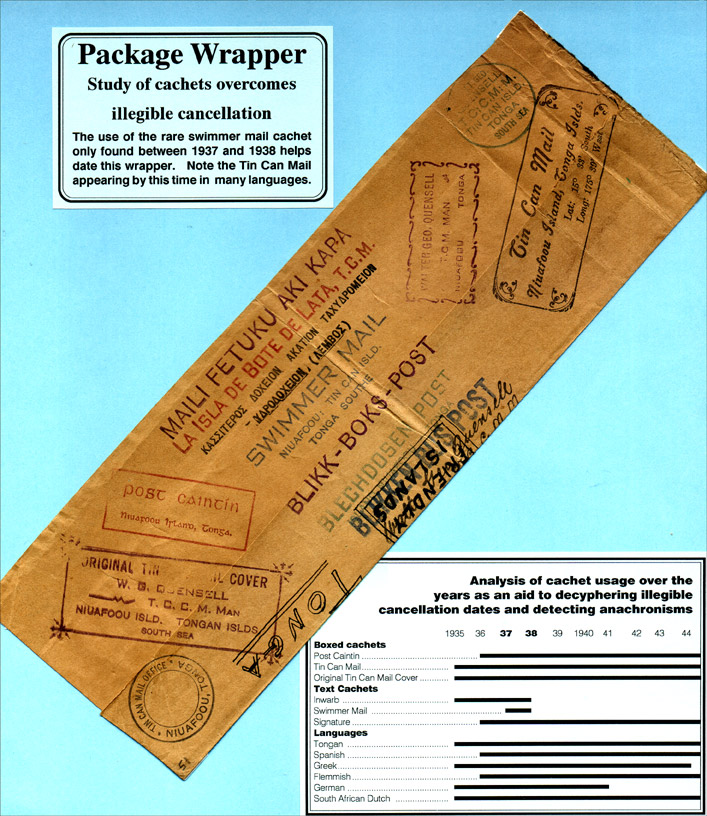
Quensell lamented the fact, adding that there was no way he could afford to pay that amount. We do not know what finally happened to resolve the matter but from the middle of 1935 all the rubber cachets have had the word 'canoe' literally cut out of them. As Tin Can Mail continued till 1983, we know that some agreement must have been reached but one can only wonder why that word in particular was removed. And why is it that only between 1937 and 1938 did the very rare 'swimmer mail' cachet appear? |
 |
 |
|