HMS Leith calls at Niuafo'ou |
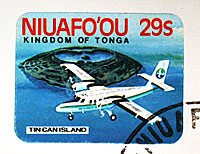 |
|
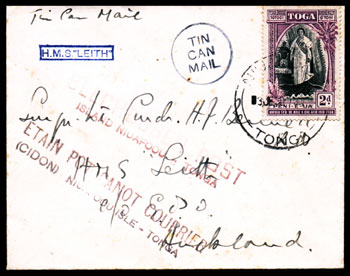
As soon as I laid hands on this unique cover with HMS Leith on it, I was curious about the ship. What was a Royal Navy warship doing in these waters just a couple of months before WWII broke out? |
||
|
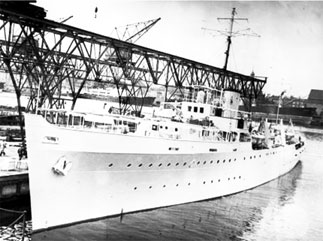
What sort of ship was she? How big? Further research uncovered that she was in fact a Grimsby Class Sloop (Frigate) of 990 tons destined for Pacific duty. Built in Devonport Dockyards, UK and launched 9 Sept 1933 she carried 9 guns and was one of several including HMS Wellington, built for the express purpose of protecting convoys. |
 |
|
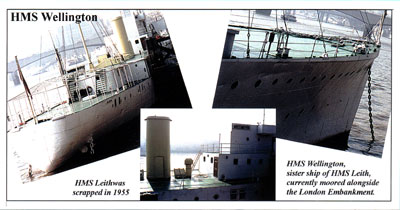 |
This was important because she has long since been broken up; however, her sister ship HMS Wellington is tied up by the Embankment in London, UK. So off I went to photograph her. |
|
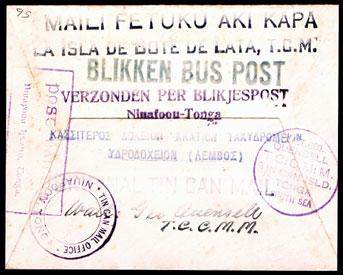
The envelope was addressed to Lieutenant Commander H J Bennett, Auckland. Was he actually the Captain of HMS Leith, writing a letter to himself at the next port of call so that he could get Quensell’s cachets? Was he a philatelist? Quite possible, because, strangely enough, this is the ONLY known cover from this particular ship - or any Naval vessel as far as I am aware. |
 |
|
The 1930 total eclipse of the sun indicated several pacific islands as being ideal from which scientists could make observations. In the course of further searches both the British and the Americans noted that the Island of Canton had a splendid lagoon in which seaplanes could settle, as well as a flat rim for land planes. Both laid claim by building monuments with their flags. |
|
|
HMS Leith's War Service mainly took place in the Atlantic, including the landings in North Africa, but after the end of WWII (1946) she was sold to the merchant navy. Here I should have left her as she was no longer near Niuafo’ou but by then I had become particularly fascinated by her interesting life story which was unfolding. Named BYRON of Panama in 1947 she was then sold to the Danish part of the World Friendship Association in 1948 and renamed yet again - FRIENDSHIP. I cannot find out details of what she did at this time though I got a hint that she was sailing around South America. |
|
The really interesting bit comes in August 1949 when she was bought by the Danish Naval Department to be used for a planned 2-year Deep Sea Expedition circumnavigating the world, surveying and mapping the sea bed. |
|
|
After extensive sea trials she was again renamed, this time the GALATHEA and captained by Commander C H A Madsen, she set off and I only discovered her again in an interview given by Dr Isobel Bennett, the well-known marine biologist who wrote several books on sea life around the coasts of Australia and the Barrier Reef. Note the name Bennett - the same as the Commander on my envelope! Were they related? Or was it just coincidence? |
 |
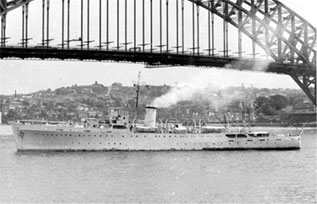 The Galathea steaming under Sydney Harbour Bridge |
I Quote her: “I went on part of the Danish ship Galathea’s around-the-world cruise in 1951–52. The idea for the cruise had come from the young zoologist and the young naval lieutenant who knew about the voyage of original Galathea 100 years before, but the Danes were unable to carry it out until a few years after the war. They purchased an old British ship - HMS Leith, I think - and manned her mainly with students doing their National Service. She was run as a naval ship. |
|
Because of the expense, at the various places they visited, they would take on a scientist or two to experience the life on board. For example, they picked up a scientist in New Guinea, brought him to Brisbane, and then brought another one to Sydney. Thus I sailed with 113 Danish sailors down to Melbourne. |
|